


Discover the full biography of Taimi Li in 2026 — Jet Li’s eldest daughter. Explore her age, height, education, career as an ophthalmologist, family background, siblings, net worth, and private life in this comprehensive, updated profile.
Quick Facts: Taimi Li at a Glance
| Detail | Information |
|---|---|
| Full Name | Taimi Li |
| Date of Birth | July 6, 1989 |
| Age (2026) | 36 Years Old |
| Place of Birth | Beijing, China |
| Nationality | Chinese |
| Ethnicity | Asian |
| Zodiac Sign | Cancer |
| Father | Jet Li (Li Lianjie) |
| Mother | Huang Qiuyan |
| Siblings | Si Li (full sister), Jada Li, Jane Li (half-sisters) |
| Height | 5 feet 5–6 inches (165–168 cm) |
| Weight | Approximately 52 kg |
| Hair Color | Black |
| Eye Color | Dark Brown / Black |
| Education | Beijing Huijia Private School |
| Career | Ophthalmologist (Eye Doctor) |
| Net Worth | Estimated ~$300,000 |
| Marital Status | Unknown / Not Publicly Disclosed |
| Religion | Not Publicly Disclosed |
| Social Media | Not Active |
Taimi Li Biography
When people hear the name Jet Li, they picture gravity-defying kicks, iconic martial arts films, and one of the greatest action stars to ever grace the screen. But behind that legend lives a private family — and at the heart of it is his eldest daughter, Taimi Li. Unlike her father, who built a career under the world’s brightest lights, Taimi has deliberately chosen a quieter road. In 2026, she remains one of the most talked-about yet least-seen celebrity children, a woman who has defined herself on her own terms rather than trading on a famous surname.
This biography brings together everything known about Taimi Li — her roots, her upbringing, her education, her professional life, and the values that guide her.
Taimi Li Family Background

Taimi Li was born on July 6, 1989, in Beijing, China, to two people who were far more than just romantic partners — they were teammates. Her father, Jet Li (born Li Lianjie on April 26, 1963), was already a rising star in Chinese cinema and a decorated Wushu champion. Her mother, Huang Qiuyan, was a fellow member of the Beijing Wushu Team and a former actress in her own right. The two reportedly met as children around the age of 11 during martial arts training, and their bond deepened over years of shared discipline and competition.
Jet Li and Huang Qiuyan married in 1987, and together they welcomed two daughters into the world: Taimi Li and Si Li. However, their marriage lasted only a few years, ending in divorce in 1990 when Taimi was barely a toddler. Despite the separation, both parents are reported to have maintained a cooperative co-parenting relationship, ensuring their daughters were shielded from the chaos that often follows high-profile splits.
Taimi grew up surrounded by extended family warmth. Her paternal grandparents, Li Qingquan and Zhang Fenglan, along with her maternal grandparents, Huang Bo Tao and Chen Liang Huan, were part of her early life. She also shared her childhood years with paternal uncles Li Lianli and Li Liansheng, and aunts Li Lianping and Li Lianzhu — a large, close-knit family unit that clearly grounded her in Chinese cultural values.
Taimi Li Mother: Huang Qiuyan
Taimi’s mother, Huang Qiuyan, is a woman of quiet distinction. She was a professional martial artist who competed alongside Jet Li on the Beijing Wushu Team before transitioning into acting. After her divorce from Jet Li in 1990, Huang Qiuyan stepped away from public life, choosing to raise her daughters with dignity and privacy. Very little is publicly known about her life post-divorce, which reflects a deliberate choice that Taimi appears to have inherited. Huang Qiuyan remains one of the most private figures in Jet Li’s story — respected, but rarely discussed.
Taimi Li Siblings
Taimi Li is one of four daughters in Jet Li’s blended family. Her full sister, Si Li, was born shortly after Taimi from the same parents — Jet Li and Huang Qiuyan. The two sisters grew up together and share a particularly close bond.
After Jet Li’s divorce, he went on to marry Hong Kong actress Nina Li Chi in 1994, a relationship that has endured to this day. Together, they have two daughters: Jada Li and Jane Li — Taimi’s half-sisters. While Jada and Jane have occasionally surfaced in public or media contexts due to their mother Nina’s higher visibility, Taimi and Si have remained consistently out of the spotlight. The four sisters represent a blended family that, despite its complicated structure, appears to be held together by mutual respect and Jet Li’s fatherly devotion to all his children.
Taimi Li Age
As of 2026, Taimi Li is 36 years old, having been born on July 6, 1989. Her zodiac sign is Cancer — a sign often associated with emotional depth, family loyalty, and a preference for private, domestic life over public fanfare. Those qualities seem to describe Taimi well. She has spent over three decades building a life far from the cameras that followed her father everywhere, and in doing so, she has aged with quiet grace.
Taimi Li Height
Taimi Li stands approximately 5 feet 5 to 5 feet 6 inches tall (around 165–168 cm) and weighs approximately 52 kilograms. She has black hair and dark brown eyes — physical features she shares with her Chinese heritage. By all accounts, she carries herself with a composed, understated elegance that suits her private lifestyle. There are no confirmed public appearances or red carpet photos to reference, which speaks to just how deliberately she has kept herself out of view.
Taimi Li Education
Taimi Li received her foundational education at Beijing Huijia Private School, one of China’s well-regarded international schools known for nurturing both academic excellence and cultural values. The school’s reputation for balancing traditional Chinese education with modern curriculum made it a fitting environment for a young woman of Taimi’s background.

Beyond her schooling in Beijing, the specifics of her higher education remain private. However, given that she is widely reported to have pursued a career in medicine — specifically ophthalmology — it is reasonable to conclude that she underwent extensive university-level medical training. Ophthalmology requires a medical degree followed by specialized postgraduate training and residency, suggesting that Taimi committed years of serious academic work to reach her professional standing. Her educational journey reflects a dedication to a field that demands far more than celebrity privilege.
Taimi Li Career
One of the most defining facts about Taimi Li is what she chose not to do. She did not pursue acting. She did not enter martial arts professionally. She did not attempt to build a public brand on the strength of her father’s name. Instead, Taimi Li is reported to have pursued a career in medicine, specifically as an ophthalmologist — a doctor who specializes in the diagnosis and treatment of eye conditions and disorders.
This career choice tells you a great deal about who Taimi Li is. Ophthalmology is among the most demanding medical specializations, requiring rigorous education, clinical precision, and genuine intellectual commitment. It is not a path taken for recognition; it is a path taken out of purpose. While many celebrity children gravitate toward entertainment or entrepreneurship, Taimi chose a profession where her work speaks entirely for itself.
She is also believed to support her father’s philanthropic activities, particularly the One Foundation — Jet Li’s charitable organization that focuses on disaster relief, mental health awareness, and suicide prevention. This involvement, quiet and unannounced as it is, points to a woman who is motivated by contribution rather than attention.
Taimi Li as an Ophthalmologist
Taimi Li’s reported career as an ophthalmologist is perhaps the single most impressive detail in her biography. It sets her apart from nearly every other celebrity child of her generation. While her half-sisters have been photographed at events and occasionally discussed in entertainment media, Taimi has been building something in an entirely different world — a medical career.
Ophthalmology is a surgical specialty. Eye doctors in this field treat everything from glaucoma and cataracts to complex retinal diseases. To practice at this level, Taimi would have completed a full medical degree, a general internship, and a specialized ophthalmology residency spanning several years. The fact that she reportedly pursued this path while maintaining total media anonymity is a quiet achievement that most people would find remarkable.
There is, it should be noted, some variation in sources regarding the confirmed nature of her career. However, the ophthalmologist detail is referenced consistently across multiple biographical sources and aligns with the broader picture of a woman who values substantive work over public recognition.
Taimi Li Net Worth
Taimi Li’s net worth is estimated at approximately $300,000 as of 2026. This figure is based on speculation, as she has never publicly disclosed any financial information. Her income, if derived from a medical career, would be consistent with a professional salary rather than entertainment wealth. By contrast, her father Jet Li’s net worth is widely estimated at around $250 million — a figure built over four decades of blockbuster films and global brand recognition.
That Taimi has chosen a path that yields a modest, self-earned income rather than leveraging her family’s fortune is itself a statement about her character. She has not pursued celebrity, endorsements, or social media monetization. What she has is what she built herself.
Taimi Li Private Life
If there is one thing the world knows for certain about Taimi Li, it is that she does not want the world to know much. She has no confirmed social media presence on Instagram, Facebook, Twitter, or any other public platform. She makes no public appearances. She gives no interviews. She exists almost entirely outside the media ecosystem that her father spent decades navigating.
This is not accidental. Jet Li himself was deliberate about protecting his older daughters, Taimi and Si, from public exposure during their formative years. That protection appears to have shaped Taimi’s own worldview. She has extended it into adulthood, constructing a life in which privacy is not a limitation but a considered value.
Whether she is currently in a relationship, married, or has children of her own is entirely unknown. No credible source has confirmed any details of her romantic or personal life, and speculation remains just that — speculation.
Taimi Li Religion
Taimi Li’s religious beliefs have never been publicly confirmed. Growing up in Beijing with a Chinese family background, she would have been exposed to cultural elements of Buddhism, Taoism, and broader Chinese philosophical traditions — all of which have influenced Jet Li’s own publicly expressed spiritual outlook. However, no direct information about Taimi’s personal faith is available, and any assertion in this area would be purely speculative.
Taimi Li and Jet Li: Father-Daughter Bond
Despite the distance that fame creates, Taimi and her father are believed to share a warm and genuine relationship. Jet Li has been open about his deep love for all four of his daughters across different interviews over the years. His decision to shield Taimi and Si from media scrutiny during their childhood was a deliberate act of fatherly protection. Taimi’s reported involvement in his One Foundation charitable work further suggests that the connection between father and daughter has translated into shared values rather than just shared blood.
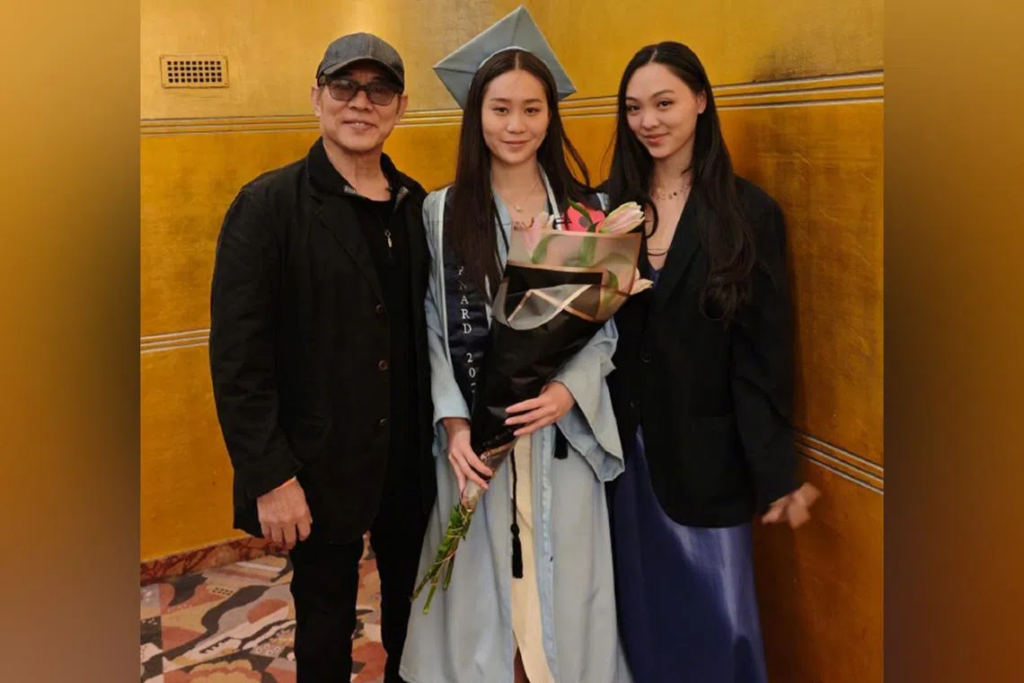
Jet Li’s own health challenges in recent years — including his publicized battle with hyperthyroidism and spinal issues — have brought family support into sharper focus. By all indications, Taimi has been a quiet but present part of that support system.
Taimi Li Photos
Taimi Li has no confirmed public photo record as an adult. There are no verified social media accounts, no red carpet appearances, and no official portraits that have been released to the media. Some older photos circulate online under her name, but their authenticity is difficult to verify. Her choice to remain visually absent from public life is consistent with every other aspect of her approach to privacy. For a woman born into one of the most photographed families in Chinese cinema, this is a remarkable and intentional stance.
Taimi Li 2026 Updates
In 2026, not much has changed in Taimi Li’s public-facing story — and that, arguably, is the update. She continues to live away from the spotlight, reportedly maintaining her medical career, supporting her family, and building a life defined by personal values rather than public perception. There are no reports of new media appearances, interviews, or public events. She remains as private as ever.
What has changed is the cultural conversation around her. As audiences grow more interested in the lives of celebrity children who choose quiet paths, Taimi Li has emerged as a figure of genuine fascination — not for what she does in public, but for what she has chosen not to do. In an era of relentless self-promotion, her silence reads as its own kind of statement.
Final Thoughts
Taimi Li’s story is not one of action sequences or award ceremonies. It is the quieter story of a woman who inherited an extraordinary legacy and chose to honor it by forging something entirely her own. She is the eldest daughter of a global icon, the product of a martial arts dynasty, and a trained medical professional — all at once. In 2026, she stands as a reminder that the most compelling personal narratives are sometimes the ones that stay out of the headlines entirely.





One Comment